By prinasieku

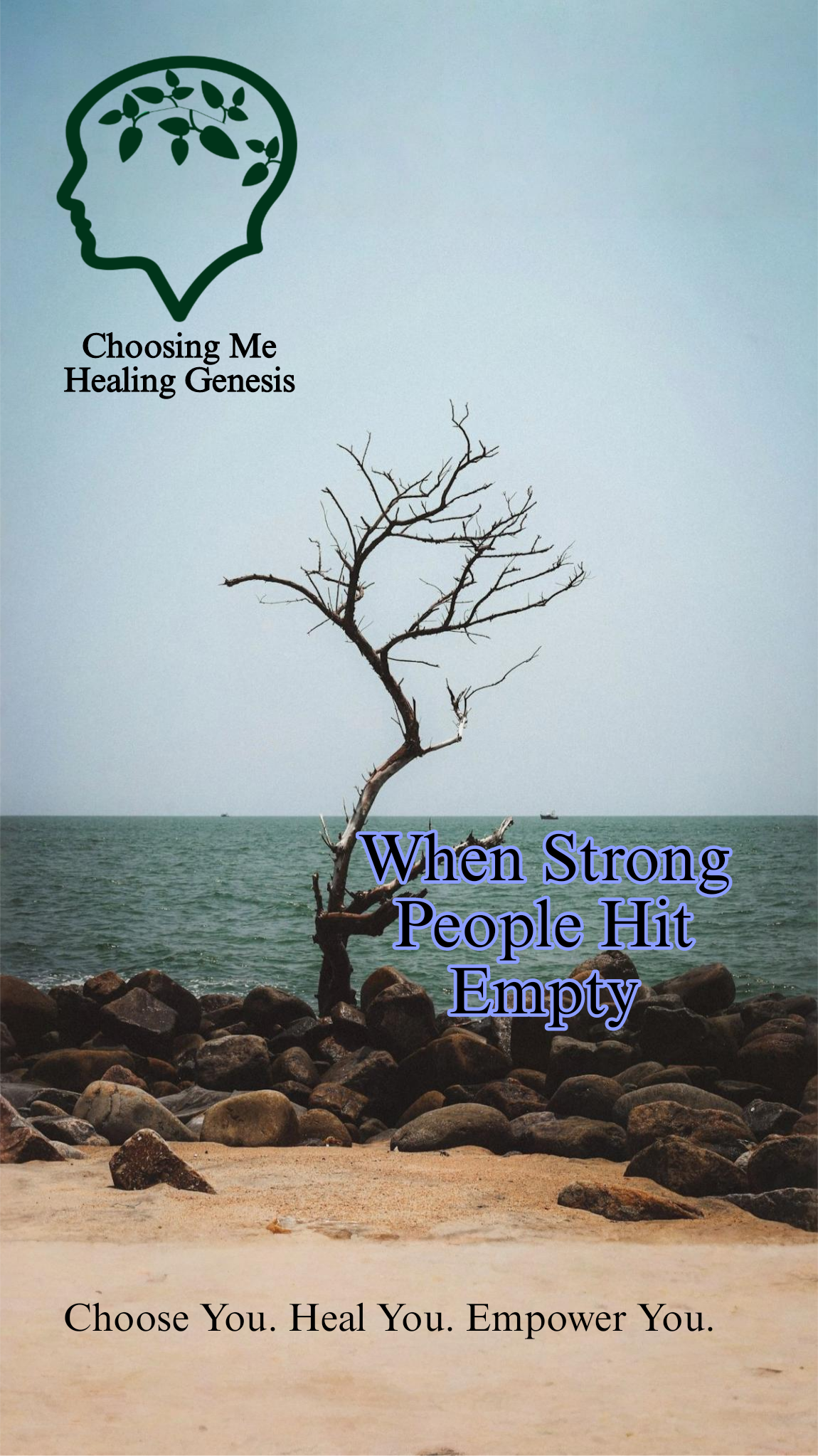
When Strong People Hit Empty

Strength has a limit. And when you hit it, the crash is louder than anyone realizes.

Everyone loves the strong ones. They’re the ones you call when you can’t hold it together. The ones who nod, who reassure, who carry more than they should and still smile while doing it. People assume their capacity is endless. They assume resilience comes with no breaking point.

But strength is expensive. And it runs out.

When you hit empty, it’s not the big storms that drown you. It’s the little things. The text that doesn’t come. The plan that falls apart. The noise in your head that won’t switch off. The body that aches in ways you can’t explain. Decisions that should be simple—what to eat, what to wear—suddenly feel impossible. Small drops start to feel like floods.

And here’s the thing: strong people rarely collapse loudly. They don’t fall apart in front of everyone. They don’t announce, “I can’t do this anymore.”

They go quiet.

They retreat.

They keep functioning on the outside while falling apart inside.

Strength doesn’t always vanish with a bang. Sometimes it fades quietly until even breathing feels like effort.

The cost of carrying too much for too long is real. You can’t keep pouring without being filled. You can’t keep holding everything together without the weight eventually crushing you.

And this is the truth most people never say out loud: hitting empty doesn’t mean you’re weak. It means you’re human.

So if you’re the strong one, and you’re tired, and you’re stretched, and you’re secretly breaking—this is me telling you: you’re not alone. You don’t have to keep pretending.

Strength has a limit. And when you reach yours, the bravest thing you can do isn’t to keep pushing. It’s to stop. To rest. To let someone else carry you for once.

Even strong people hit empty. Especially strong people.
By prinasieku

Failing Enough

Failing — and failing enough — is one of the most important things we can do. Yet for the longest time, I treated it like something to hide. I didn’t want anyone to see the cracks, the wrong turns, the moments I fell flat.

Most of us don’t. We curate the parts of ourselves that look good, the chapters where the story worked out. We post the wins, not the losses. And when we do share the losses, it’s often because we can’t hide them anymore — or because we’ve found a crowd that makes it safe. Suddenly, failure feels lighter when it’s shared. We reframe it: It’s not really failure if we all went through it, right? We pin it on our chest like a badge, convincing ourselves it’s a mark of honor.

But I’ve learned that a lot of this is smoke and mirrors. We’re not fighting the world’s opinion half as much as we’re fighting our own. The world… honestly doesn’t care.

The truth is, if you want to live authentically, you have to fail — not once, but repeatedly. Deeply. Uncomfortably. That’s the only way you become someone who’s worth the thing you’re chasing. And yes, it will look different for everyone.

We only make failure heavy when we give it power it doesn’t deserve — when we shrink from it, fear it, or let it define us. Take away that negative power, and failure stops being the enemy. It becomes proof you were brave enough to try.

Because the people who’ve never failed enough?

They’ve never lived enough.

By prinasieku

I Am the Stuck

You think you hate me.

But you don’t.

You cling to me.

I’m the weight on your chest when the world says, go.

I’m the voice that tells you, stay right where you are.

I am not laziness.

I am not fear.

I’m older than that.

I’ve been growing inside you with every broken promise you made to yourself.

Every time you swallowed your pain and smiled.

Every night you told yourself tomorrow would be different.

I was there, collecting the pieces you left behind.

You call me stuck.

But I’m protection.

I’m the wall between you and the disappointment you can’t handle again.

I hold you still so you won’t fall.

You think you want to fight me.

But deep down, you’re afraid of who you’ll be without me.

Because moving means risking everything.

And I know—you’re not ready for that.

So I’ll stay.

As long as you let me, I’ll stay.

And with every day you don’t move, I’ll take a little more of you.

Until there’s nothing left but me.

By prinasieku

Some Endings Leave Echoes

Some goodbyes don’t come with closure.

Some losses aren’t loud.

And some endings — even if they weren’t real, even if they lived only in our minds or screens or hearts — still leave us grieving.

We attach.

To people. To stories. To dreams.

We walk with characters, live inside chapters, get entangled in slow burns and unspoken words and quiet sacrifices.

And then… it’s over.

And no one warns you how empty you might feel.

Not because you’re weak.

Not because you’re overreacting.

But because you cared. You felt. You were there. Fully.

We don’t talk enough about this kind of heartbreak.

The kind that comes after finishing something that mattered.

A show. A season of life. A friendship. A hope.

Something that held you. Helped you. Changed you.

And now it’s gone.

And maybe you find yourself lingering in the silence it left.

Scrolling. Rewatching. Waiting.

Not ready to let go — not yet.

Because it wasn’t just a thing you liked.

It was something you loved.

So if you’re feeling that ache —

that strange grief after a story ends, or a chapter closes —

I hope you know this:

You’re not silly. You’re not too much.

You’re deep. And you’re human.

And every time something moves you that deeply, it’s proof that your heart is still soft. Still open. Still alive.

What a gift.

Maybe that’s the real magic:

That we can feel things that weren’t even “real” and still be changed by them.

Still grow. Still heal. Still find pieces of ourselves in the echoes they leave behind.

So take your time.

Grieve the ending.

Sit in the ache.

And when you’re ready…

let something new find you.

Not to replace what you lost —

but to remind you that there’s always more waiting to be felt.

By prinasieku

To Be Human

To be human is to ache and to long.
It is to carry contradictions: strength and softness, faith and doubt, brilliance and brokenness — sometimes all at once.

It’s waking up hopeful, and by evening, questioning everything.
It’s loving people who may never love us the same way back.
It’s fighting for dreams we sometimes don’t believe we deserve.
It’s messing up, apologizing (or not), and trying again.

To be human is to need — not just food or water — but meaning, belonging, connection.
To be held. To be known. To be seen in all our rawness and still not be left.
It’s laughing inappropriately at funerals and crying in the middle of supermarkets.
It’s finding God in unexpected places and still sometimes feeling abandoned by Him.

Being human means we carry invisible weights no one sees, and still show up.
It means we grieve people who are still alive.
It means we bleed from things no one touched.
It means we carry stories that don’t make sense, and wounds that didn’t ask for permission.

And maybe… maybe being human is also about becoming.
Not just who we were born as — but who we choose to be, especially when it’s hard.
It’s forgiving without closure.
It’s staying tender when life wants you to harden.
It’s hoping again even after disappointment.
It’s choosing to break cycles, even though we were raised inside them.

To be human is weighty and wonder-filled.
Not perfect. Not painless. But deeply worth it.
Because somehow, in all the mess and miracle, we get to live this one wild life — as we are.


By prinasieku

Still Standing

There’s a strange kind of exhaustion that doesn’t show on your face.

It’s not loud. It doesn’t cry in public.

It just sits there — quietly — in your chest. Heavy.

Like you’re breathing through wet cotton.

You’re not falling apart exactly.

But you’re not okay either.

You’re just… still standing.

Barely.

Sometimes, that’s what survival looks like.

Not thriving. Not conquering. Not even hoping.

Just getting through one more day without sinking.

You might have days where you’re too tired to hope,

too disappointed to pray out loud,

too emotionally drained to even scroll social media without flinching.

Everything feels loud.

Everyone feels far.

And yet…

somehow…

you’re still here.

Still showing up.

Still brushing your teeth.

Still making uncomfortable peace with unfinished prayers.

Still carrying dreams that feel too fragile to say out loud.

Still loving people who don’t always notice when you shrink.

There’s no medal for this.

No applause for the quiet work of holding yourself together.

But God, it takes everything sometimes, doesn’t it?

And if this is you

if you’ve been walking through June with a full heart and an empty tank,

if you’ve been asking for just one thing to finally break through,

if you’ve been tired of the waiting and the hoping and the repeating…

I hope you know this:

You are not weak for being worn out.

You are not failing just because it’s been slow.

You are not alone just because no one sees how hard it’s been.

Sometimes life brings us back to ourselves

through silence.

through stillness.

through small sacred visits that remind us we are not as lost as we feel.

And sometimes, the breakthrough doesn’t come loud.

It comes in the form of a breath you didn’t realize you were holding.

Or a heaviness that starts to lift.

Or the simple fact that you’re no longer afraid to go back…

because this time, you’re going back different.

Still tired.

Still waiting.

But stronger.

Wiser.

More grounded.

Still standing.

And honestly? That’s no small thing.

By prinasieku

When You Don’t Have the Words

Some days, it just hits.

Not like a storm, not like a crash.

But like a quiet undoing.

You’re lying there.

Not really crying. Not really sleeping.

Just… drained.

Done.

There’s this weight in your chest, but you’re too tired to name it.

You try to trace what exactly is wrong, but your brain can’t even hold the questions.

You don’t want to be comforted.

You don’t want to be told it’s going to be okay.

You don’t want anything.

Not really.

Even your face feels heavy.

Even blinking takes effort.

And everything—everything—feels too loud, too far, or too much.

You’re not trying to be dramatic. You’re not looking for attention.

You just feel… folded. Curled up in your own mind.

Not angry. Not fine. Just there.

And maybe you’re not asking for help out loud,

But somewhere in the middle of the fog, there’s still that whisper:

“God, I need help.”

No fancy words. No energy for holy things. Just that.

A breath. A plea. A letting go.

So if you’re here—where everything hurts and nothing makes sense—

You’re not alone.

This isn’t the end of your story.

You don’t have to move. You don’t have to fix it.

You can just be.

And somehow, even now, you’re still held.

Even now, you’re still breathing.

And that’s enough for today.

By prinasieku

When Pain Demands Payback

There’s this thing that happens. When someone hurts you—really hurts you— it’s not always sadness that shows up first.

Sometimes, it’s fire. This unbearable urge to lash out. To hurt them the way they hurt you. To shake something. Break something. Say that one thing that will land like a slap.

And in that moment, it feels like the only way to breathe again. Like if you don’t release it—this rage, this ache—you might explode.

So maybe you do. You say it. You do it. You let it out.

And for a moment… relief. The heavy cloud lifts. The pain shifts. You feel powerful. Not the helpless one anymore.

But then comes the silence. The echo. The guilt. Now you’re not just the one who was hurt— you’re the one who caused hurt too.

And it’s a sickening trade.

People don’t always talk about this part of us. The part that wants payback. That wants someone else to carry the pain for a while. That wants to stop feeling like the victim and start feeling like the one in control.

But that version of control—it lies. Because the pain doesn’t go away. It just changes address. You mail it off to someone else and hope it won’t come back. But it always does. In guilt. In shame. In regret.

And just like that, you’re no longer the wounded. You’ve become the weapon. But even then… it doesn’t heal anything. Only hides the wound deeper.

By prinasieku

The Art of Becoming

There are days you want better.
You wake up and think, “Okay, let’s try again today.”
Maybe it’s something small—like breaking a habit.
Or holding a boundary.
Or making a choice you know deep down is good for you.

But then that moment comes.
The actual doing.
And suddenly it feels like someone just asked you to run a marathon… barefoot… uphill… with no warning.

The task might be small on paper.
But in your body? It feels heavy.
And you’re tired.
Tired from last week.
Tired from carrying things no one sees.
Tired from always trying to be a better version of yourself without ever quite feeling like you arrive.

And you find yourself thinking:
“Must I really do it?”

We don’t talk enough about how inconvenient growth actually is.

People throw words like discipline and consistency around like they’re light and fluffy.
Like they don’t cost you something.
Like they don’t quietly rearrange your whole life.

But the truth?
Trying to “do better” can feel like losing parts of yourself.
Your comfort.
Your coping mechanisms.
Your routines.
Even your old identity.

And for what?
Some future version of you that feels far off and a little blurry?

So, yeah—you hesitate.
You stall.
You bargain with yourself: Maybe later. Maybe when I feel stronger. Maybe when I care more.

But sometimes, there’s no magical push.
No rush of motivation.
Sometimes, all you’ve got is guilt.
Or a little leftover compassion.
Or a memory of someone who once believed you could.

And so you cling to that.

Because maybe this isn’t about being deeply inspired.
Maybe it’s just about not wanting to stay stuck.

Truth is, staying committed isn’t always pretty.

Some days you hold on because of that version of you who first dared to hope.
Other days, it’s someone else—
God.
Your therapist.
A younger you.
A random quote you saved to your phone months ago.

And then there are days when it’s just guilt.
Ugly, gnawing guilt that whispers, “Why are you like this?”
“Why can’t you just get it together?”

But let’s be real.

Wanting better while also hating the process of getting there?
That doesn’t make you broken.
Or weak.
Or bad.

It just makes you human.

Maybe sacrifice and commitment aren’t that different.

Sacrifice says, “This will cost you.”
Commitment says, “Stay with it anyway.”
But real life?
It blends the two.

Because choosing better—really choosing it—means saying goodbye to the parts of you that picked comfort over growth.
And that comes with grief.

Even if the old you wasn’t helping you, it was still familiar.
It was still yours.
Letting that go hurts more than most people admit.

So if you’re in that messy middle—between I want better and I don’t want to do what it takes—
you’re not the only one.

You’re not lazy.
You’re not failing.
You’re just standing at the edge of who you were and who you’re trying to become.
And that’s a hard place to be.

Maybe the real strength isn’t in doing it perfectly—
but in showing up anyway.

In dragging yourself through the hard bits,
Not because you’re full of inspiration,
But because something in you still wants to care.

So the next time you ask yourself,
“Must I really do it?”
Let the answer be a little softer.

No, you don’t have to.
But if you do—
Let it be because you love who you’re becoming.
Because you’re tired of being stuck.
Because healing matters.
Because even if today, you’re barely holding on… you’re still holding on.

By prinasieku

Who Even Was That?

There are moments that play back in the mind like a scene someone else acted out. A look. A comment. A tone. A decision that, at the time, felt small—but now feels sharp and out of place. Almost like it came from someone else entirely.

But it didn’t.

It came from a tired version of self.

An overwhelmed version.

Maybe even a hurt one.

And still, there’s that ache that follows after. That uncomfortable thought:

Why did I do that? Who even was that?

It’s strange how quickly regret shows up. Not always loud, but steady.

Not just because of what happened—but because of who might’ve seen it. A stranger in the room. A barista. A driver. A colleague. Someone who caught that version, without context, without a second chance. And just like that, that becomes their memory of who you are.

God forbid there’s a reunion down the road.

An accidental meeting. A mutual friend. A job interview.

And the only thing they remember is that one off day, that one bad moment.

No space for a do-over. No way to explain, That wasn’t me. Not fully.

That’s the part that stings most—knowing it can’t be taken back.

Some call it overthinking. Others call it caring too much. But maybe it’s just being human. Wanting to be someone who leaves gentleness behind, not discomfort. Someone who doesn’t just feel sorry, but wants to grow. Not out of shame—but out of love for the kind of person they’re becoming.

Because truthfully? No one gets it right all the time.

And the goal was never perfection anyway.

The goal is awareness. Softness. That quiet shift toward becoming better—not flawless, just better.

Sometimes that shift looks like choosing silence over sarcasm.

Or stopping mid-sentence when the tone starts to go sharp.

Or forgiving the moment before it hardens into identity.

And even when the cringe is real and the memory lingers—

There’s room to let grace cover what can’t be undone.

So when the guilt gets loud, let grace speak louder: You messed up, yes. But you’re still good. And you’re still growing.